Apple introduces its first touchscreen MacBook Pro, featuring a vibrant OLED display, M5 Pro and M5 Max chips, and the return of its glowing logo.
Blog Post
Apple unveils its first touchscreen MacBook Pro in a major shift for Mac design and a nostalgic return
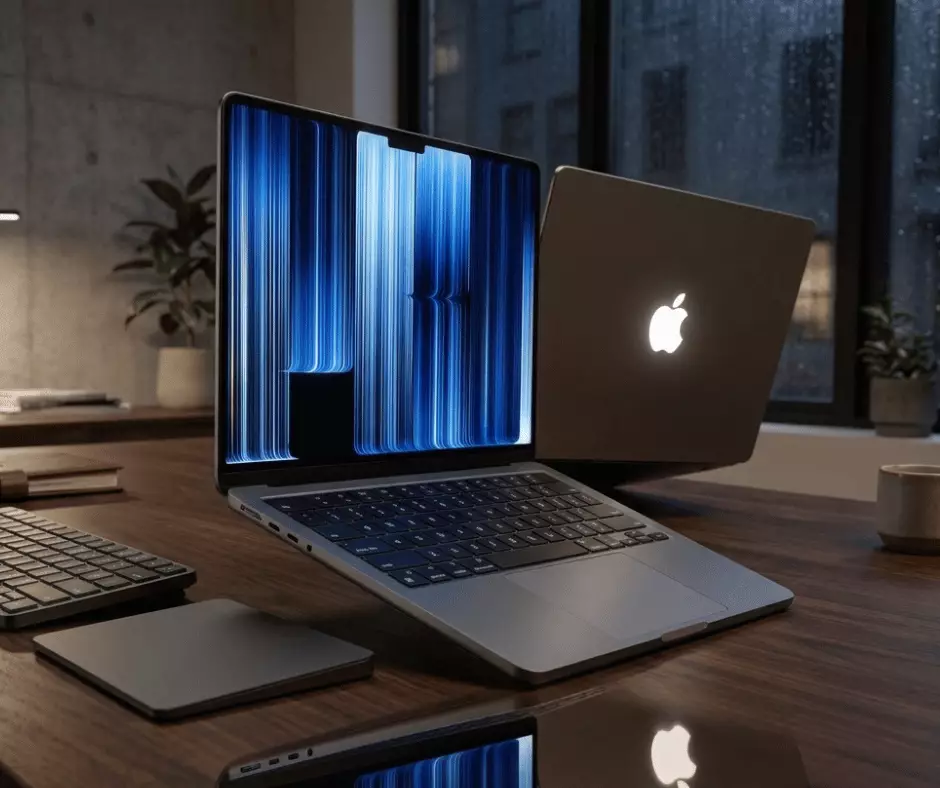
Apple has officially introduced its first touchscreen MacBook Pro, marking a significant change for one of its most recognisable products. Announced on 28 October 2026, the redesigned laptop features a PROLED XDR display, touch controls and M5 Pro or M5 Max chips. It also brings back a familiar feature that longtime Mac users may remember fondly: the glowing Apple logo on the back of the screen.
The announcement combines a major change in how people interact with their computers with a return to one of Apple's most recognisable design details. After years of relying on keyboards and trackpads for the Mac, Apple is introducing touch interaction while revisiting a feature that disappeared from its laptops a decade ago.
Apple finally brings touch controls to the MacBook Pro
The biggest change is the ability to interact directly with the display. Users can scroll through webpages, zoom into photographs, move presentation slides and manipulate visual elements with their fingers, while continuing to use the keyboard and trackpad whenever they prefer.This flexibility could be particularly useful for designers, video editors and other creative professionals who frequently work with visual content. Touch controls give users another way to interact with their applications, although their practical value will depend on the task and how well individual applications support the new experience.
A new OLED display designed for creative professionals
The new PROLED XDR display uses tandem OLED technology to deliver deep blacks, high contrast and detailed colour reproduction. With peak brightness of up to 2,000 nits and a refresh rate of up to 120Hz, it is designed to produce vivid images and smooth movement.Support for P3 and Adobe RGB colour spaces is especially relevant to photographers, video editors and graphic designers who depend on accurate colours. Combined with touch interaction, the display offers new possibilities for working directly with digital content, from adjusting visual elements to navigating creative timelines.
The glowing Apple logo makes a long-awaited comeback
One of the most nostalgic details is the return of the illuminated Apple logo on the laptop lid. Apple removed the glowing logo from the MacBook Pro following its 2016 redesign, replacing it with a reflective logo that did not light up. Its return after roughly a decade gives the new model a familiar touch that longtime Mac users may appreciate.The original glowing logo became a distinctive part of Apple's laptop identity, making MacBooks instantly recognisable in offices, cafés and classrooms. Its appeal was largely visual, but it became a memorable design detail for people who grew up using older MacBooks. Bringing it back shows how a small feature can carry considerable emotional value, even when it has little effect on a computer's performance.
The new model also demonstrates how design can evolve alongside changing hardware. Tandem OLED technology uses individually illuminated pixels rather than a conventional backlight, so the new illuminated logo requires a different implementation from the older designs. It is a small detail compared with the touchscreen and display upgrades, but one that adds personality to the redesigned laptop.
More processing power for demanding projects
The touchscreen MacBook Pro comes in 14-inch and 16-inch sizes with M5 Pro and M5 Max processors. Depending on the configuration, the models support up to 128GB of unified memory, up to 16TB of storage and up to 24 hours of battery life, according to Apple.These capabilities are designed for demanding workloads such as software development, high-resolution video editing, 3D rendering and data-intensive research. Thunderbolt 5 connectivity also supports high-speed data transfer and compatible external devices, making it useful for professionals working with large files and multiple displays.
It is important to distinguish these touchscreen models from Apple's separate 14-inch MacBook Pro with the M6 chip. The M6 model is a different product update and does not feature the new touchscreen PROLED XDR display.
What Apple's announcement means for the future of computing
Apple's latest MacBook Pro illustrates how established products can evolve while retaining the qualities that made them familiar. Touch interaction introduces another way to work, the new display supports demanding creative tasks, and the returning logo reconnects the redesigned laptop with its history.For businesses, the announcement offers a useful lesson about technology investment. New features can create opportunities, but their value depends on whether they solve genuine problems. Organisations should consider their users, workflows, budgets and long-term requirements before committing to new systems or upgrading existing ones.
The same principle applies to software development, infrastructure and digital transformation. A carefully planned investment can improve efficiency and support growth, while a poorly matched solution can introduce unnecessary complexity and ongoing costs.
Make smarter technology decisions with CTO Partners
Choosing the right technology requires a clear understanding of business priorities, technical requirements and long-term goals. CTO Partners provides fractional CTO leadership, supported by expertise across software development, infrastructure, DevOps, security and digital strategy, helping businesses evaluate their options and establish practical technology roadmaps.Whether you are planning a new digital product, improving existing systems or preparing your business for growth, CTO Partners can help you make informed technology decisions that align with your objectives. Contact us now to learn more!
Share this post
Subscribe to get exclusive content
See Latest News


CTO Partners
Ready to Start?
Talk to us about your technology needs and find the right Fractional CTO support for your business.